

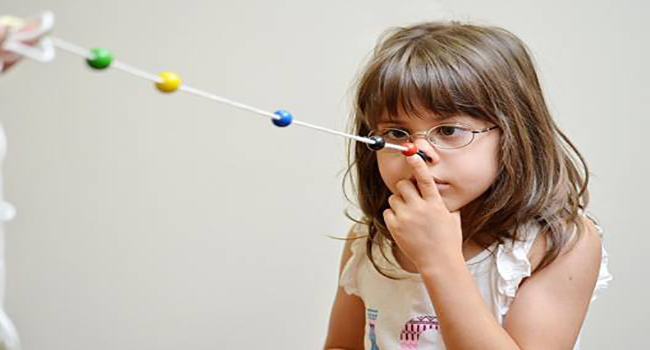
Brock String Exercise (Bead String) | A Fundamental Vision Therapy Technique for Improving Binocular Vision
The Brock String, also known as the Bead String exercise, is one of the most effective and widely used vision therapy techniques for improving binocular vision, eye teaming, convergence, and depth perception. This simple yet powerful tool provides immediate visual feedback and helps patients learn how to use both eyes together efficiently.
At Soroosh Vision Therapy Clinic, Brock String exercises are commonly incorporated into individualized treatment programs for patients with convergence insufficiency, strabismus (eye misalignment), amblyopia (lazy eye), suppression, and other binocular vision disorders.
What is a Brock String?
A Brock String consists of a white cord approximately 3 meters long with several movable colored beads placed at different fixation distances. During the exercise, patients are trained to accurately coordinate both eyes while focusing on targets.
The technique was developed by the Swiss optometrist Frederick W. Brock, one of the pioneers of modern vision therapy. His work significantly contributed to demonstrating that binocular vision and stereopsis (depth perception) can be improved beyond early childhood through structured visual training.
How is the Brock String exercise performed?
One end of the string is attached to a fixed object, while the other end is placed just beneath the patient’s nose. Typically, three beads are positioned at different distances:
• Near bead: approximately 50 cm from the nose
• Intermediate bead: approximately 1.5 meters away
• Far bead: near the end of the string
The patient sequentially focuses on each bead while maintaining single, clear vision. When binocular alignment is functioning properly, the patient should perceive one bead with two strings crossing precisely at the fixation point, creating an “X” pattern.
The beads that are not being fixated may appear slightly blurred or doubled. This is a normal response known as physiological diplopia and indicates that both eyes are contributing appropriately to visual processing.
Therapeutic Goals of Brock String Training
Brock String exercises are designed to improve several essential visual skills, including:
• Eye teaming and binocular coordination
• Convergence and divergence control
• Sensory fusion
• Depth perception (stereopsis)
• Fixation accuracy
• Suppression awareness and reduction
• Visual attention and peripheral awareness
Clinical Applications
Brock String is commonly used in vision therapy programs for patients with:
• Convergence insufficiency
• Convergence excess
• Intermittent strabismus
• Amblyopia (lazy eye)
• Suppression
• Reduced binocular vision efficiency
The level of difficulty can be adjusted by changing the position of the beads or by incorporating lenses and prisms into the therapy program.
Why is Brock String important in Vision Therapy?
Brock String is both a diagnostic and therapeutic tool. It allows clinicians to assess binocular vision performance while simultaneously training patients to improve visual efficiency. Because it provides immediate visual feedback, patients can quickly recognize whether both eyes are working together correctly.
Its simplicity, effectiveness, and adaptability have made Brock String one of the cornerstone techniques in modern vision therapy programs for both children and adults.
Have questions about Brock String exercises or binocular vision problems? At Soroosh Vision Therapy Clinic, our doctors are here to provide clear answers and personalized guidance. Feel free to reach out—successful visual rehabilitation starts with expert evaluation and individualized care.