
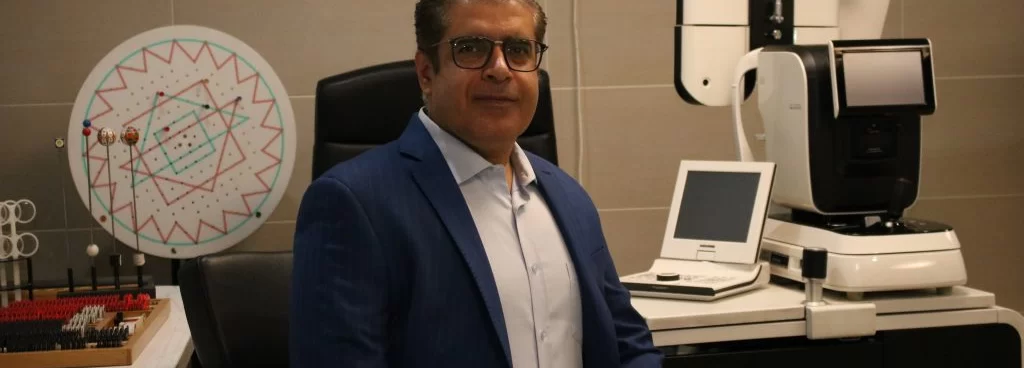
You may have also asked yourself what vision therapy is. In fact, it is a set of vision exercises to improve vision skills and strengthen eye muscles with the aim of increasing the performance of the brain’s information processing system and visual perception, creating better eye coordination in performing skills such as reading, learning, exercising, and driving.
On the other hand, vision therapy can also be used to treat eye deviations without the need for surgery, treat eye headaches and visual fatigue, improve learning, and strengthen visual perception. Vision exercises are also effective in hyperactive children, autism, and people with a history of brain injuries and neurological problems.
Perhaps you are one of the people who experience good vision with glasses, but still do not feel the necessary comfort in your eyes when performing eye tasks, or you feel sleepy after studying, or you experience pain and fatigue, and sometimes you feel that you do not have the necessary concentration and sufficient understanding in performing eye tasks. Vision therapy plays a role as an effective treatment method to resolve such eye problems.

Is vision therapy effective in treating lazy eye?
It is definitely effective and is considered one of the effective methods of treating lazy eye. If a child has lazy eye and the parents are tired of closing their eyes, this treatment method can be considered a suitable choice to speed up the treatment process and get more cooperation from the child. In this case, the need for prolonged closing of the eyes in a child with lazy eye will be eliminated and the treatment process will be accelerated. If you are one of those people who do not have astigmatism, but are unable to understand the images of 3D televisions or get headaches when watching, you should also choose vision exercises or vision therapy.
1- People with lazy eye, deviation or squint
2- People who have double vision and see objects in pairs.
3- People who have insufficient convergence and experience lack of focus at close range while performing eye tasks.
4- People who have poor binocular vision skills and the eyes do not have the necessary coordination to perform chasing and jumping movements while reading and fine eye tasks and sports skills such as tennis.
5- People who experience occasional blurring, visual fatigue and headaches after close eye work, whether reading or working with a computer.
6- People with visual fatigue and headaches
7- Athletes for whom coordination of the eye with the hand, foot and brain is essential and shortening the athlete’s reaction time in sports skills, which is a necessity, can be achieved with vision therapy.
8- People with visual motor perception impairments such as hyperactive people, autism, etc.
9- People in need of visual rehabilitation such as brain injuries due to trauma, stroke, and cerebral palsy
10- People with learning-related vision problems.

When the eye becomes deviated, parents have one of two choices:
In some cases of surgery, repeated surgeries may be required, due to the change in the angle of deviation as the child grows and over time. For this reason, there are parents who are looking for an alternative to surgery, and today’s science offers them vision therapy. This treatment method consists of a set of sensory-neural and neuromuscular activities that are performed under the supervision of an optometrist trained in this field, and the skills and function of the visual system are improved during treatment, and as a result, the patient’s visual system is in optimal conditions in terms of visual perception.
In fact, the potential of visual skills is empowered to the extent that the eyes learn how to keep themselves straight and get out of the deviation state.
Although the patient will be satisfied with the appearance after surgery and in many cases the eyes will straighten after surgery, we must keep in mind that the deviated or strabismus eye still does not have sufficient vision and the brain’s ability to use the eyes together is insufficient and the necessary coordination in the eye muscles has not been strengthened. Therefore, by using vision therapy, by trying to fix the main problem, which is to help the brain’s ability to use the eyes, it is possible to improve visual function and treat the deviation, which ultimately leads to straightening the eyes.
Since in vision therapy we teach the brain how to maintain eye coordination, the brain no longer needs to make an effort to prevent double vision and as a result, the root cause of the problem is treated.
And not only are the eyes straightened at the end of the treatment, both eyes have also learned to send images to the brain in coordination so that the person can enjoy comfortable and efficient vision.
What is the next step for me?
Contact Soroush Vision Therapy Center for a complete visual function assessment. All you need is a phone call to this center and an appointment. A successful and efficient vision therapy program based on the most up-to-date methods in the world will be set up for you at this center. So that people with lazy eye and astigmatism problems can benefit from the necessary changes in their visual system and put their visual system at the highest level of visual function, both in terms of vision and visual perception.